-
Lacazette, i can tell you that a lot of scientist and companies lie about their papers and products just to get public attention and money. How we will know that some paper from scientist work on human? How we will know that somenthing publiced is not a lie? -
Foo I understand what you mean, but we don' talk about the same kind of papers. You're talking aobut when they announce a precisely big treatment for a type condition,etc.. whereas here it's more various details improvements, ameliorations, technologies discoveries that are making the regenerative medecine clinically applicable
for exemple there were issues for safer reprogramming process, sendaivirus vector was created that lead to free dna damage, and can be purchased now all over the world. There's also now their world wide agreement to sell their combo sendaivirus/naive state that offer better benefit. and another company sell safe reprogramming process protocols with the use of RNA that it seems to be even more powerful
So does it took here 10/15 years between discovery and practical use? no, the majority of papers here are achievements for technology/knowledge improvement to make things cheaper, faster, easier, safer on the iPSCs treatments area. When these kind of breaktroughs comes out it's a matter of months or even days for other researchers to use it or replicate the protocol
we don't talk here about a treatment that has to be proven as you mentionedLeave a comment:
-
Lacazette, thank you very much for your job here. Its really great, but you are too naive man. Science dont work in that way. For every science breakthrough they need another 10-15 years to proove if treatment is working or not, so this papers are nice, but everything sounds nice on papers. Reality is very different.Leave a comment:
-
Haha you're right that they will not joke with any kind of mini safety issue
but for the moment all things good, this patient is doing well for a month, and the japenese woman with iPSCs passed the one year timeline without any problems, so let's hope it'll continue well like that
Patient doing well one year after world's 1st iPS clinical trial
Jiji Press -- Oct 03
And this women was treated with 'dangerous' iPSCs , when they transplanted her in 2014, there wasn't the 100% DNA damage free iPSCs and safe reprogramming process. In fact they didn't even know at that time that the replicative stress during the reprogramming process was leading to small mutations
so i wouldn't be that afraid with safety issues, dna mutations that could lead to cancer is THE safety concern, and is being solved these last months, so Im quite confident personnalyLeave a comment:
-
I think that there is a good chance that there will be safety concerns because they are not just looking for obvious safety issues. They are looking for even a hint of a safety issue. They are looking for even a hint of a theoretical safety issue. I think that the odds are that there will probably be some safety issues.Leave a comment:
-
Few other recent advances
-Researchers identify protein crucial for stem cell survival
http://phys.org/news/2015-08-protein...vival.html#jCp
In a multidisciplinary effort, a team of University of Wisconsin-Madison engineers has identified a protein that is integral to the survival and self-renewal processes of human pluripotent stem cells (hPSC).
The goal for many researchers who work with stem cells is simply to produce an environment that allows the cells to support their own survival. By identifying α-5 laminin as an important key to a cell's survival, the researchers can work to create a synthetic culture environment that encourages the protein's production, says Saha.
Designing new synthetic substrates is about providing a receptive surface that keeps what the cells are producing endogenously in the right place, he says.
"This work gives us a better idea of how to improve the substrate to make a completely defined and inexpensive culture system that's synthetic," says Palecek.
-Researchers develop a method for controlling gene activation (in iPS cells)
http://phys.org/news/2015-09-method-gene.html#jCp
Researchers at the University of Helsinki, Finland, have developed a new method which enables the activation of genes in a cell without changing the genome. Applications of the method include directing the differentiation of stem cells.
The hottest topics in stem cell research at the moment are methods that can regulate the differentiation of cells. The differentiation process is based on how genes in a cell are activated and deactivated, so researchers are looking for ways to control the activation of the genes.
Researchers in Otonkoski's laboratory have now developed a method that enables the regulation of a single gene's behaviour without changing the genome itself. The method employs CRISPR technology, but the regulation itself is controlled by the addition of chemicals. The desired gene is made receptive to the drug by introducing bits of RNA into the cell that will bind to the activator protein and the gene's regulatory area. The gene will then activate in the desired way when the chemicals that regulates the activator protein are provided to the cell.
-A fast and comprehensive method for determining the function of genes could greatly improve our understanding of a wide range of diseases and conditions
http://phys.org/news/2014-01-rewirin...ells.html#nRlv
Mutations with important biological effects can then rapidly be traced to individual genes by next generation DNA sequencing.
"This is a powerful and revolutionary new tool for discovering how gene circuits operate," said Dr Leeb. "The cells and the methodology we've developed could be applied to a huge range of biological questions."
-Hormone found to be critical in promoting growth of human embryonic stem cells, paving way for improved regenerative medicine and cell-based therapies

Singapore – Scientists from A*STAR’s Institute of Medical Biology (IMB) have discovered that the recently-identified hormone ELABELA is critical in promoting the growth of human embryonic stem cells (hESCs), suggesting its potential as a target for applications in tissue engineering and regenerative medicine.
So far, only a few growth factors for hESCs have been discovered. In a ground-breaking study, IMB has now identified ELABELA as necessary for hESCs to self-renew and differentiate, making it a potential target to stimulate hESC growth, and ensuring its stability for use in regenerative medicine
By activating this pathway, ELABELA also protects the hESCs, and therefore presumably early human embryos, against the intrinsic cell death (apoptosis) pathway which is activated by a variety of cellular and environmental stresses. Given the high susceptibility of hESCs to spontaneous apoptosis and differentiation, ELABELA not only enhances their growth, but also performs the critical function of ensuring their survival.
In regenerative medicine, a key problem is ensuring the stability and survival of hESCs for future differentiation and transplantation. IMB’s discovery implies that clinicians and scientists can target and manipulate ELABELA in order to ensure optimal hESC growth during scale-up of cell production for clinical applications, thus making regenerative medicine cheaper and more accessible, and increasing the chances of successful cell replacement.Leave a comment:
-

London Monday 28 September: A pioneering trial of a new treatment derived from stem cells for people with ‘wet’ age-related macular degeneration (AMD) has commenced at Moorfields Eye Hospital following a successful operation on a patient.
Doctors at the Moorfields Eye Hospital in London have used specialized eye cells derived from embryonic stem cells and grown on a synthetic scaffold to try to reverse blindness caused by age-related macular degeneration(AMD). Prior clinical trials have injected similar cells but without the supporting structure of the patch to hold them in place.
Also, prior trials have aimed to halt the progressive loss of vision in the dry form of macular degeneration. This trial is trying to reverse damage already done by the wet form of AMD. Each of the groups use embryonic stem cells and first mature the cells into a type of cell found in the back of the eye’s retina, retinal pigmented epithelium (RPE) cells.
The first surgery was successfully performed on a patient last month and there have been no complications to date. The patient wishes to remain anonymous, but the team hope to determine her outcome in terms of initial visual recovery by early December (2015).
“The reason we are very excited is that we have been able to create these very specific cells and we have been able to transfer them to the patient,” lead researcher Lyndon Da Cruz told a writer for the Huffington Post. “It’s the combination of being able to create the cells that are missing and demonstrate that we can safely transplant them.”
CIRM funds a team at the University of Southern California and the University of California, Santa Barbara that has collaborated with the London team and plans to use a similar patch system on a trial set to begin in the next few weeks.
“We are delighted to be the site for this very exciting new clinical trial in stem cell therapy, which has the potential to give hope and make such a difference to the lives of people with blinding retinal conditions,”.
We’ve been hearing a lot this week about an important new clinical study for macular degeneration in the UK. This team is using retinal pigmented epithelial cells (RPEs) made from embryonic stem cells (ESC). They are now testing safety.
There’s real reason for excitement in this area more broadly and that context is important to include, but many newspaper articles haven’t.
For instance, Ocata Therapeutics is doing very similar clinical work and is already years into its FDA-approved clinical trials for macular degeneration using RPEs made from ESC. So far that work has proceeded really well without safety concerns and with hints of efficacy. Also the clinical study in Japan for macular degeneration using IPS cells, while at present on hold, will likely start up again in a new iteration later this year or more likely in early 2016."
it's the same protocol of different hair cure strategies on the making: make the right cells, grow them on a scaffold to then transplant them
so let's all cross our fingers that everything goes well in this trial in term of safety ( with the stemcells post transplant, it's ESCs so it's similar of iPSCs but without the reprogramming process so more safe but still with safety concerns unanswered, and really hope for safety and any kind of problems for using the scaffold thing as we will need that)
Cause if big safety problems comes out, it will add maaany months/years on other regenerative therapies timelinesLeave a comment:
-
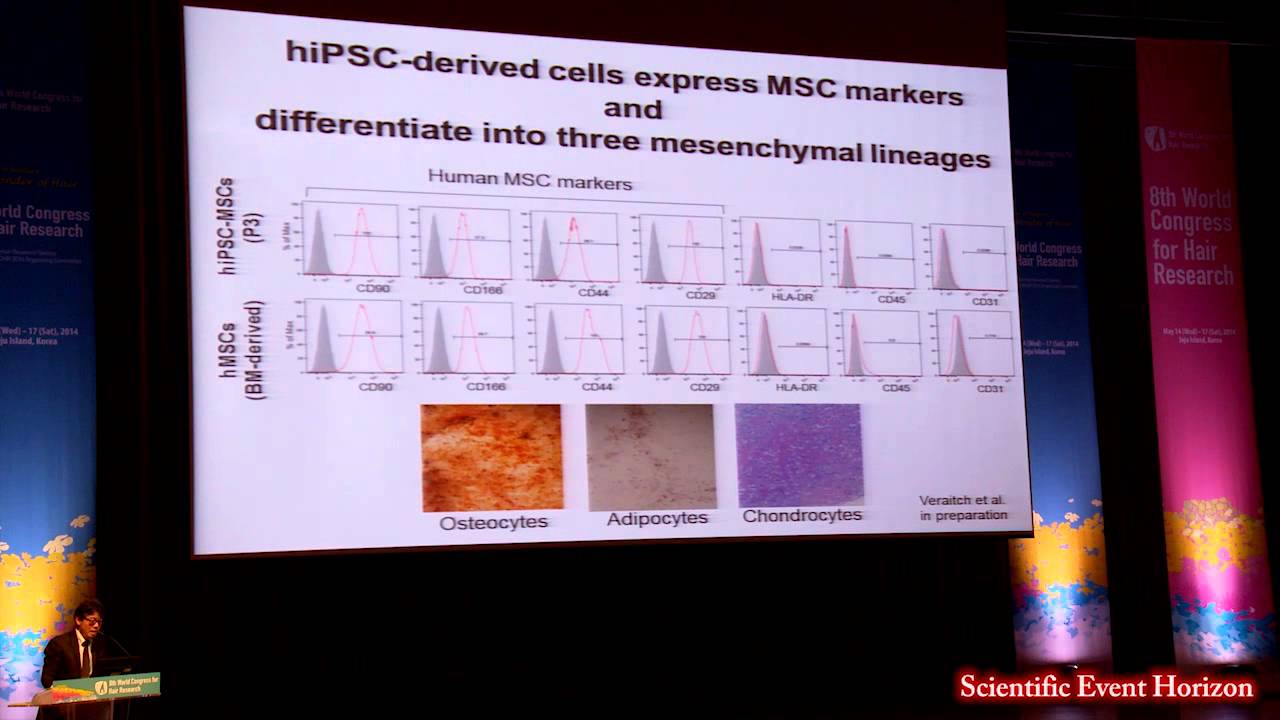
Excellent presentation by Ohyama about iPS cells. Worth a repost imo! Exciting.
Leave a comment:
-
totally agree Joachim, progress is going exponential, we will be surprise in the coming years and not only for hair but for our health and people we care about deadly diseases
Some quotes from takahashi before summer:
Some mutations were detected in the iPS cell-derived RPE product, prepared for the second patient.
“The mutated genes were not driver genes for tumor formation,” wrote Takahashi
Although the mutations were identified before transplanting cells into the second patient, and the mutations may have contributed to RIKEN’s decision not to treat, the main reason not to go ahead with the trial was because of a “regulatory change,” says Takahashi.
there is no guidance in new regulation about “allowable” level of mutations and methods of their detection in iPS cell products:
… there is no regulation with which medical professionals are obligated to check gene modification for organ transplantation, mesenchymal stem cell injections or autologous cell therapy.
The fact remains that we do not have clear guidelines today on which the whole community can reach a consensus that “the second” RPE cells are safe enough for implantation .
As a pioneer of iPS cell clinical application, Riken took the responsible decision not to rush ahead with the second patient’s RPE cells, which could potentially damage the whole field of regenerative medicine.
Although therefore, the cells were widely thought to be safe to use, after careful consideration, they made the decision that they would not implant another autologous cell sheet until such guidelines could be officially authorized.
They are now coordinating the discussions at the Ministry of Education, Culture, Sports, Science, and Technology, and also at the Ministry of Health, Labor and Welfare to carefully discuss these issues with key opinion leaders in the field including government officials, regulatory experts, scientists and toxicologists.
RIKEN is moving forward with allo- iPS cell-derived RPE. Moving together with CiRA. Well characterized partially matched lines with “safety clearance” by rigorous QC testing.Leave a comment:
-
it's crazy if you think about it. the discovery of iPS cells happened only 9 years ago, in 2006. before that discovery scientists had no clue that mature cells could be kicked back to a stem cell state and then again differentiated into any other cell type. it changed the knowledge of how cells work among scientists. and only 9 years after that mankind-changing discovery, we have the first human application seen in this woman, with many more applications for different diseases to follow. i believe we will see a firework of iPS news in the upcoming months and years. all that pre-work for other diseases will highly help establishing a hairloss treatment when all pieces come together.
that said, thinking that a real hairloss cure is always 10years away, is just ridiculous.
with japan's fast tracking i think, everything is possible, and a cure within the next 5 years is not unlikely.Leave a comment:
-
Hey jay , with NYSCF robot , and ameliorations in this kind of robot , large autologous should still be feasible for a big company, less cheaper and less faster expansion than allogeneic of course but as NYSCF explained, one machine can make thousands of iPSCs from a patient specific stem cells
Though autologous don't really matter as allogeneic ipscs use will also be for us don't worry dude. This kind of robot from NYSCF will do the job:
* The NYSCF Global Stem Cell Array
Building a bank of 2,500 stem cell lines representing the genetic diversity of the United States and the world.
This revolutionary global resource will equalize access for safe and effective medicine for EVERYBODY including underserved populations.
This critical step between animal testing and human testing will transform drug development by cutting down years of time and billions of dollars currently spent on human clinical trials and ultimately accelerating the approval of new drugs and therapies by the FDA.
Bone Regeneration: NYSCF is using iPS cells and embryonic stem cells to produce personalized human bone grafts that will be used to treat and repair damaged bones. These bone grafts will be patient-specific, avoiding immune rejection. This will be the first time we will have vascularized bone grafts that are engineered using human cells.
Also regarding the ermegence of stem cells banks
September 1, 2015
San Francisco, CA –The largest publicly available stem cell bank in the world is now open for business. In September the bank is offering the first 300 different stem cell lines for researchers interested in gaining a deeper understanding of, and developing treatments. CIRM has teamed up with the Coriell Institute and Cellular Dynamics International (CDI) to open what will be the world’s largest publically available stem cell bank. It officially opened today. In September the Bank will have 300 cell lines available for purchase but plans to increase that to 750 by February 2016.
-Sept 8,CiRA, Hitachi to produce, store iPS cells from healthy donors for research
To advance stem cell research, Kyoto University's Center for iPS Cell Research and Application (CiRA) and Hitachi Ltd. will be producing induced pluripotent stem (iPS) cells from healthy subjects and storing them in a cell bank.
CiRA and Hitachi said on Sept. 7 that they will be producing iPS cells from blood donated by healthy subjects to store at the Riken BioResource Center's Cell Bank together with anonymized data of the donors' medical records.
Jay, I'm not 100% sure but I think with one iPSC line we can make an unlimited amount of cells (derived dermal papilla cells for exemple) , so the match donor question will not be that complicated. robots will do the job, for large banking, and then to find matches
Apparently 2500 lines represent the world genetic diversity , I though it was much higher than thatLeave a comment:
-
“As of now, autologous would not be a feasible way of providing wide level clinical therapy,” says CiRA spokesperson Peter Karagiannis. “At the experimental level it’s fine, but if it’s going to be mass produced or industrialized, it has to be allogeneic.”
This isn't so good for us however. In Asia they have all the stem cell lines to be able to do this. However in the west we don't and to be able to set up the amount of stem cell lines needed to cover the much more vast genetic differences wont be worth the cost - until stem cell and iPSC therapies take off.
This is what i keep mentioning to people who think shiseido will be a cure with iPSC's.Leave a comment:
-
Some quotes from Gladstone Institutes twitter during Dr Takahashi award, I like what i read:
Gladstone Institutes @GladstoneLabs 16 hil y a 16 heures
The first patient to receive a transplant with iPSC is healthy and doing well, with no adverse events #OgawaYamanaka
Gladstone Institutes @GladstoneLabs 16 hil y a 16 heures
The next step is to use iPSC from #stemcell banks in order to conduct more surgeries faster and cheaper #OgawaYamanaka
Gladstone Institutes @GladstoneLabs 16 hil y a 16 heures
Dr. Takahashi's groundbreaking work conducting first transplant using iPSC in retina paves way for future iPSC surgeries for other diseases
Gladstone Institutes @GladstoneLabs 16 hil y a 16 heures
Japan has created a new law to expedite translational research using #stemcells, but emphasis is still on safety #OgawaYamanaka
Gladstone Institutes @GladstoneLabs 16 hil y a 16 heures
Safety requirements should be consistent for #stemcell research: right protocols ensure tumors don't form, even w/ genetic changes in cells
Gladstone Institutes @GladstoneLabs 16 hil y a 16 heures
For regenerative medicine to succeed, science, regulation, and industry must work together for the best of the patient #OgawaYamanakaLeave a comment:
-
Hey nameless, don't know for the moment, they are choosing the best way for reprogramming,etc and that lead to new regulations tools to take in place. so since this summer it should be a matter of weeks. Aswell as CIRA and cha who annouced planning few trials this year
@barfacan do you read the last pages man? I thinked not based on your other posts safety and practical human application is making his road right now. It's the commercialisation that is far away ( though the temp approval makes it not that far)
@Swooping Thanks bro i hope aswell that breaktroughs comes out as fast as these last 2 months. 100% Safety is the last issue that slow everything, and it's being overcomed now (if not already), the science world work on it so just a matter of days unlike hairloss news
My bad i totally forgot the livestream of Dr Takahashi last night due to champions league
but they say the podcast will be available online today at 11:30 AM Pacific Daylight TimeLeave a comment:
-
Lacazette you are a beast at digging up information! Great job.
Some promising therapies are coming our way, that's for sure. Hopefully it will be as quick as possible.Leave a comment:


Leave a comment: